Sunday, October 25, 2009

I take it back - See 2 posts down

It appears to be a problem with the Blogger server. Some outages are causing the blogs to be unable to read the updates from other sites. It's intermittent, which is why some blogs are updating, while others are still left lower in the queue.

Discovery

One page 192, Shade actually predicts his unfinished poem! In his posthumously published poem, "The Nature of Electricity" Shade writes about the nine-hundred-ninety-ninth lamp post and an old friend. The poem Pale Fire is 999 lines long and the last four are:
"And through the flowing shade and ebbing light
A man, unheedful of the butterfly--
Some neighbor's gardener, I guess--goes by
Trundling an empty barrow up the lane."
The hi-lighted words create the setting for John Shades death! Shade walks through the encroaching dusk. He sees a butterfly (but true to dead Aunt Maud's warning [p. 188], does not heed it). The gardener is present (although we don't know his name. We do, however, know that Kinbote had a crush on him [p. 290-292]). The gardener does not, in fact, have a wheelbarrow, but instead a trowel with which he disarms Gradus. However, it may be important to note that one of the definitions of barrow is also a grave or burial site.

Friday, October 23, 2009

OMG! It's working again!

I can see the newest posts that people have made now! Yay, for what ever happened! :D

Monday, October 19, 2009

This is a test

I'm not sure, but I don't think that the blogs are updating properly on my blog. Has anybody noticed this? I'm posting this to see if it bumps my blog up in the list, which hasn't changed in 4 days, and doesn't display a snippet of my latest post.

Sunday, October 18, 2009

There is such a bird as a silktail. Unfortunately, it doesn't look like the waxwing and lives in the Pacific Islands not east coast US.

Thursday, October 15, 2009

Royal Game of the Goose


Developed during the Renaissance, the Royal Game of the Goose is very similar to the children's game of Chutes (or Snakes) and Ladders. Why does Starover Blue remind Kinbote of the Game of Goose? He seems to be trying to connect the game to the phrase "wild goose chase", but I can't find confirmation that the term came from that game. (Rather, it seems to have been a sort of steeple chase in which the lead horse and rider would set the pace and direction while the following riders had to keep up.) The Game of the Goose is based on chance. Two dice are thrown, then the player moves his or her playing piece the number of spaces shown on the dice. As in Chutes and Ladders, there are special spaces that will send the player forward or backwards. So, in the style of Nabokov, should we be paying more attention to Starover Blue because he seems to indicate that the name is just a fluke, a goose chase? Starov is a common Russian last name, also the name of a famous Russian architect in the 18th century. A Russian Blue is a breed of cat.

Oh, cool! A website dedicated to Nabokov, named Zembla!

How to know when to read the forward

I want to say, first off, that had I not read the library's copy of Lolita first I would not have read the forward to Pale Fire. I am a a creature of habit and like constancy, so when I saw that Lolita, or what one would think was the first page, did not start at 1 but at 6 I realized that the forward was in actuality part of the story, as normally forwards, prefaces, and the like are counted with tiny Roman numerals. It is harder to tell on our copies (if you have one from the bookstore) because the copy editor numbered each page after the cover, highly irregular, so the story (counting forward) starts at page 13, go figure.


Ceder Waxing - top
Bohemian Waxwing - bottom

Tuesday, October 13, 2009

Two Page Paper

Here's a paper written on only one letter!


Camp Q was of some fascination to me in Lolita. Usually, summer camps have long flowery, flowing, frequently formidable names like Quinipet or Quinebarge or Quidnunc. Lolita’s camp is identified only as Q. Nabokov must have had a reason to give such a short name to this camp. Admittedly, the camp plays only a minor role in an otherwise clue filled book, but it is interesting to look at, never the less.

The camp is first introduced in Chapter 14, although the name is withheld. This also happens to be the same chapter in which Humbert hears Quilty’s name for the first time (he feigned a toothache at the thought of being deprived of his lust object). This is not merely an unplanned coincidence, this is the first clue that the camp and Lolita’s exile to that camp is of some importance. The following chapter, in which the camp is named, also contains Charlotte’s love letter (if it can be called that), which induces Humbert’s devious plan of marriage to Mrs. Haze if only for access to Lolita. The camp is obviously the beginning of the end for H.H.

Having such a short name, the camp seems to beg the reader to uncover its clue(s). Chapter 27 tells the reader that each cabin in the camp is dedicated to a Disney character, but, other than a few fairy queens, “Q” does not seem to reference anything about Disney. The idea about fairy queens is in keeping with the enchanted, mythological aspect of the book, but it is a meager correlation in a book full of strong relationships.

For more promising clues, the sound of “q” (incidentally, probably a dark shade of red in Nabokov’s synesthesia, which is in keeping with the red theme through the rest of the book) can be analyzed. Q or cue or queue bears many connotations that are significant to Lolita. “Q” is a nickname for Clare Quilty. “Cue” is a signal to begin: The beginning of Humbert’s flight across America with Lolita. “Queue” can be an order or sequence of events: The camp was one step closer for Humbert to get what he wanted, Lolita to himself, and ultimately to loose everything.

Nabokov rarely makes coincidences and clues so obvious, however. To dig deeper, slang is another aspect of language that he is proficient with. In A Dictionary of the Underworld one can actually find that Q by itself is slang. Referring to the cue (also Quilty's nickname) ball in a game of billiards and coined sometime in the late 19th century, Q means the initiation of a deception. Humbert initiates several deceptions throughout Lolita. With the Farlows, he intimates that he is the biological father (through an old affair) to Lolita. He hides the death of Charlotte from Lolita, saying she is just convalescing at a fictitious hospital. He plays a deception every evening at each hotel they stay at along their route. And the greatest deception of all is the one that Humbert plays on the reader. Since we can never know what actually happens except through Humbert’s eyes, we are compelled to sympathize with a pedophile and murderer; we are tricked into helping Nabokov create Humbert. “Imagine me; I shall not exist if you do not try to imagine me…” (p 129)

One other “q” word comes up when looking through slang dictionaries. “Quail” is slang for an attractive young woman. As a summer camp for girls, this could be an appropriate name for Camp Q, although it seems as weak as the Disney connection.

Nabokov obviously intended the reader to give Camp Q more than just a passing thought. The clues which are imbedded in the connotations of just the letter Q are numerous and deep. From the innocuous fairy queens to the ominous deceptions, Camp Q should not be passed over lightly.

Monday, September 28, 2009

My Quest


So I keep going back to the camp where Lolita was (chapter 27). I keep wondering what was the full name. Q couldn't be the entire name, could it? Humbert says that the cabins were named after Disney characters (p. 110), so my initial search was for Disney names. Nothing really comes up; and if the individual cabins were named after Disney characters, shouldn't the camp have a name that encompasses the whole genre? I did find reference to a Queen Clarion, who was supposed to be the head fairy for the pixies in Never Land. However, this seems to be a recent addition to Peter Pan's story (roughly 2008) so no chance that Nabokov would have considered this character even for one of the cabin names.

So I decided to look at slang and nicknames that it could possibly be. And I discovered that the letter Q could be slang on it's own! Referring to the cue (yep, also Quilty's nick name) ball in a game of billiards, Q means to initiate a deception! This reference comes from A Dictionary of the Underworld, Routledge & Kegan Paul Ltd., London, 1949. The term appears to have been coined sometime in the 19th century.

Other possible "q" names that the camp may have been named include:
  • quail-an attractive young woman (New Dictionary of American Slang), and
  • a word that refers to a particular part of the female anatomy, which I won't post (but you can e-mail me and ask), and which may make sense since the camp lake is called Climax Lake.
Also in chapter 27, Lolita reveals that she had a lover at camp (p. 112, "Fact I've been revoltingly unfaithful to you..."), spoiling the "innocence" of the nymphet for H.H. (the fact of which he doesn't get yet), although (unless you've read A.A.'s annotations) we don't know who, yet.

Wednesday, September 23, 2009

Maybe we should watch both?

Did you know that the 1997 film version of Lolita (with Jeremy Irons) is listed under the subject of "erotic films" in the MSU library catalog, while the 1962 version (for which Nabokov wrote the screen play) is listed under the subject of "sexual ethics drama" in the same catalog? Why the difference, I wonder?

Monday, September 21, 2009

Annotations to Lolita

Reading through chapters 10 & 11, I began to realize that Nabokov plays and preys on our ideas of feminine beauty in his descriptions of Lolita. Page 39: Humbert describes her (Lolita's? Annabel's? always the reader is left unsure of what vision H.H. is really seeing) "indrawn abdomen", and "puerile (meaning juvenile or not fully mature) hips". Page 41: "[m]arvelous skin...tender and tanned, not the least blemish" and her walk, "[a] faint suggestion of turned in toes" and "[a] kind of wiggly looseness below the knee". Page 42: "swelling of her tense narrow nates...and the seaside of her schoolgirl thighs." Page 43: "a stippled armpit". Page 44: "her lips as read as licked candy, the lower one prettily plump". Page 45: "the gooseberry fuzz of her shin". Page 49: "her neat calf".

Taken together; tight abdomen, small hips, smooth tanned skin, a suggestion of hips swinging, tight buttocks, clean/hairless armpits and legs, red plump lips; these form the basis of our idea of feminine beauty today. Nabokov brings into question what we regard as beauty and how it differs from the pedophile's view of the perfect girl child. Can we condemn H.H.'s attraction, if, in fact, we are striving to attain just such an image ourselves? Women spends millions every year on make-up, depilatories, gym memberships, blemish removal, plastic surgery for lips, hips, stomach, etc., and tanning salons. I think that the joke is on us for condemning the character of H.H. all the while making ourselves in the image of the perfect pubescent girl.

An interesting article on Wikipedia about shaving of leg hair (men and women): http://en.wikipedia.org/wiki/Leg_shaving. Interesting, if true, although the lack of citation makes some of it doubtful. The idea that the appearance of juvenility is actually preferred seems to be a common theme, not only in this article, but in beauty standards in general.

(This may also serve as another response to Amanda; see previous post)

To Amanda

Perhaps the great genius of Nabokov can be seen in the way he creates his "coward at heart". Not one to defend the actions of a pedophile, I would rather focus on the creation of one. H. H. draws the reader in to his story, the detective novel to which he could be said to be both the pro- and antagonist. Can just any author make a coward so interesting? I couldn't put the book down during the first reading trying to solve the "mystery" before reaching the end, where all would be reveled anyways. This second reading has been very informative, and I'm glad that I had first read Lolita in an un-annotated copy from the library (for I must confess that I am a shameless cheat, and probably would have read the annotations first had I the option).

Sunday, September 13, 2009

Common Place Books and Good Quotes

I just set up a link to my common place book. I haven't put my quotes in it yet, so you won't get very far trying to look at it. Sorry. :( But I did want to comment on Jared's latest post about Lolita. I, too, was caught up with the same line! Nabokov is bringing the reader into the the mind of Humbert, and bringing Humbert into the reader's mind. It's kind of like a sign that says "Look at me". Would we have looked at the sign had it not said that? Maybe, but the important thing is that the sign is bringing attention to itself rather than any message that it is relaying. In the same way, we are now to look at Humbert Humbert not as some message that the author is trying to relay but as his own separate entity, an entity that we actually create because we are imagining him. So, if we are personally imagining Humbert and his exploits, are we as much a part of his crimes as he is, since he wouldn't be committing those crimes if nobody was there to read about and imagine them?

Tuesday, September 8, 2009


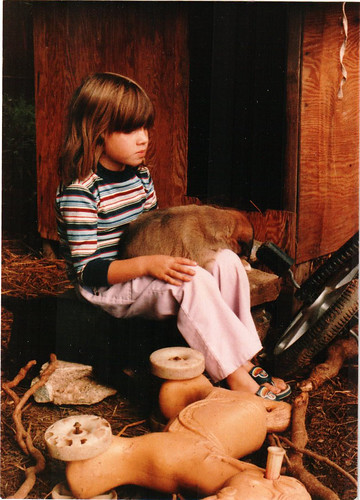
This photograph, taken when I was six, gives an interesting glimpse of my childhood. I sit on the "porch" of Rosie's dog house, our black lab given to me for my fourth birthday. In my lap I hold one of her puppies from her first litter, Rusty, which we gave to my cousins. This picture has a strangely nostalgic feel for me. It seems like a childhood in disarray. The tipped over toy horse in the foreground, obviously too small for my age with a broken front wheel, bits of sticks scattered along the ground intermingled with straw from the dog house, a crushed cinder block below me to the left, and the wheel of a plastic tricycle just visible on the right, all give the impression that things had been disrupted, dismantled. Add to that, neither I nor the puppy are looking at the picture taker (probably my mom), and it seems like a memory of a time forgotten, or, perhaps, unremembered. One might think it was summer, since I am wearing Mario Brothers flip-flops, a shirt that is possibly one or two sizes too small, and light pants, however, as this was in California, this was more likely fall. Too-long bangs hide my eyes from the viewer, adding to the impression of general neglect present in the entire photo and indicating that the school year had not yet started.

Thursday, September 3, 2009

Biographies on the 'Net

I thought it might be interesting to do a quick little internet search to find some biographies of our author. And I found something interesting. First I did a search for Faber pencils, because Nabokov writes about a four foot long one received while he was sick as a child. What I really wanted to find was a picture of the gigantic art instrument, but what came up was this: In Search of Memory Interestingly, the author of this work claims that Nabokov himself was the chronophobiac. In support of his theory, the author sites passages from Speak, Memory, rather than a third party source. So, I was interested to see how prevalent it was for biographers to refer to Speak, Memory when writing about Nabokov's life. My next Google search brought up An Absence Of Wood Nymphs, an article written for The September 14, 1959 issue of "Sports Illustrated". This is an article about Nabokov's many excursions for butterfly hunting. Again, however, the author chose to snip excerpts from Speak, Memory, rather than trying for outside sources to corroborate the authenticity of the autobiography. I'm not sure what this means, perhaps it's because he is held in such high regard as an author that it would be foolish to question is personal work, I'm not sure.

And who were Vladimir Nabokov's parents? From his autobiography, I can tell that his father was deeply involved in politics, but were they nobility or such also? He writes about playing with the family treasures; jewelry of tiaras, chokers, and rings; which would lead me to believe they were wealthy, and says that the local peasants refer to his father as "barin" which is a type of land owner, but also royalty? Are tiaras a common household item for the rich?

Wednesday, September 2, 2009

Day One of Nabokov with Dr. Sexson

The telling is in the details. Nabokov wants us to look past the obvious and examine the details. This is probably similar to catching butterflies and actually appreciating them. On a summer's walk, one may encounter thousands of bugs without ever being aware of it. Nabokov wants us to become aware (of the butterflies, at least). Butterflies are creatures that have taking the art of mimicry to a whole other level. Surely, nothing as gorgeous as butterflies could have evolved if we believe Darwin's theory. It is the attention to detail that the butterflies have developed that we should try to emulate when we read or write or perform or do anything worth doing.

The class list is a work of art. Who would have thought that it would match so perfectly the make-believe list from Lolita? The repetition found in fiction is repeated in real life. Or perhaps it's the other way around: Fiction repeats real life, so therefore our class list maybe isn't so spectacular, after all. It is a cool coincidence, however. One that would seem to be made up to an outside observer.

Monday, August 31, 2009

How to start a book

Whenever I pick up a book for the first time and read the first paragraph or two, I always wonder to myself how long the author took to create that particular opening. Starts have usually been difficult for me, and, usually, I write one that I know I will throw out in favor of a revised version, generally made after the completion of the work. I really like Nabokov's opening paragraphs to his story. I had never really thought about the world without me in it. Egocentric, perhaps, but unlike the chronophobiac in his first paragraph, I know nothing of a world before I was here, and so it has little impact on my personal consciousness. I do, however, like the idea of looking at our lives as "a brief crack of light between two eternities of darkness." (p. 1) I can relate to this, since we cannot truly know what happened before our birth and we will never know what will happen after our death. To us, then, is left only a single span of time wrapped between a pair of eternities that we can know nothing about. I would like to end on the final sentence from the second paragraph: "In order to enjoy life, we should not enjoy it too much." (p. 2) To me this means that life might get boring if we lived forever. In order to properly appreciate the time that we are given, we must have an expiration date.

Sunday, August 30, 2009

When did washable markers make their debute?

Lee Stickler's blog made me wonder: when did washable markers come out? I don't remember if the markers I used as child were washable or not, although judging from what I've found they probably were not. What I could find browsing the internet seems to indicate that Crayola introduced washable markers in 1987 and washable crayons in 1991 or 92. Here are the links if anybody is interested:
Binney & Smith History - document
Interactive Timeline
Condensed Timeline - pdf

My First Memory

My first memory goes something like this:

I wanted salt and pepper on my dinner; I don't remember what was for dinner, I just remember that I wanted salt and pepper on it. I asked for the salt and pepper, which Dad helpfully applied to my meal; I was just about two at the time. The reason that this memory stands out to me is because Dad put the pepper on the food first and I had specifically asked for the salt then pepper! I don't remember anything of the meal after that, but, checking the details of the memory with my parents, it turns out I threw my first big tantrum over that. Mom thinks we may have been having meatloaf, but Dad (who does the cooking [yeah, sort of reversed, I know]) thinks it may have been plain hamburgers with veggies on the side; it was ground beef, either way - YUCK!

So, like Nabokov, I don't always remember things as clearly as it seems I should. Being able to check with my parents was a big help. I wonder how Nabokov's autobiography would have been different had he kept a journal. Part of the reason that Mom was able to remember my tantrum is because she is a meticulous diary-keeper, and she keeps all of her diaries. It also helped that she knew what I was talking about, and knew the year that it happened, and was able to locate the date that it happened (August 23, 1983). I think that's an incredible feat of memory in and of itself, and I wonder if it has something to do with the fact that she writes everything down. I tried it for a while - keeping a diary (or journal, if you'd rather) - but it just made me realize that I never did anything worth writing down. But maybe, now that I'm starting a family of my own, I should re-evaluate the idea of diary-keeping, for posterity's sake (and just in case my son has a similar class assignment).

Wednesday, August 26, 2009

Why not Mnemosyne?, or The Problem with Memory

I feel that Mr. Nabokov received some bad advice when told he should not title this work Speak, Mnemosyne. It would really make for a more intriguing title; little old ladies be damned! But anyways, our first assignment (beyond, of course creating this blog) is to put ourselves in the shoes of Nabokov and tease from the hidden convolutions of our brains our first memory. Is this, I wonder, our first real memory or our memory of what we first remember? This is a difficult task set before us, and I must give some rumination to it before setting it to type. I do seem to recall it had something to do with salt and pepper, though.
Adopt one today!Adopt one today!Adopt one today!Adopt one today!